Skip to product information
1 of 3

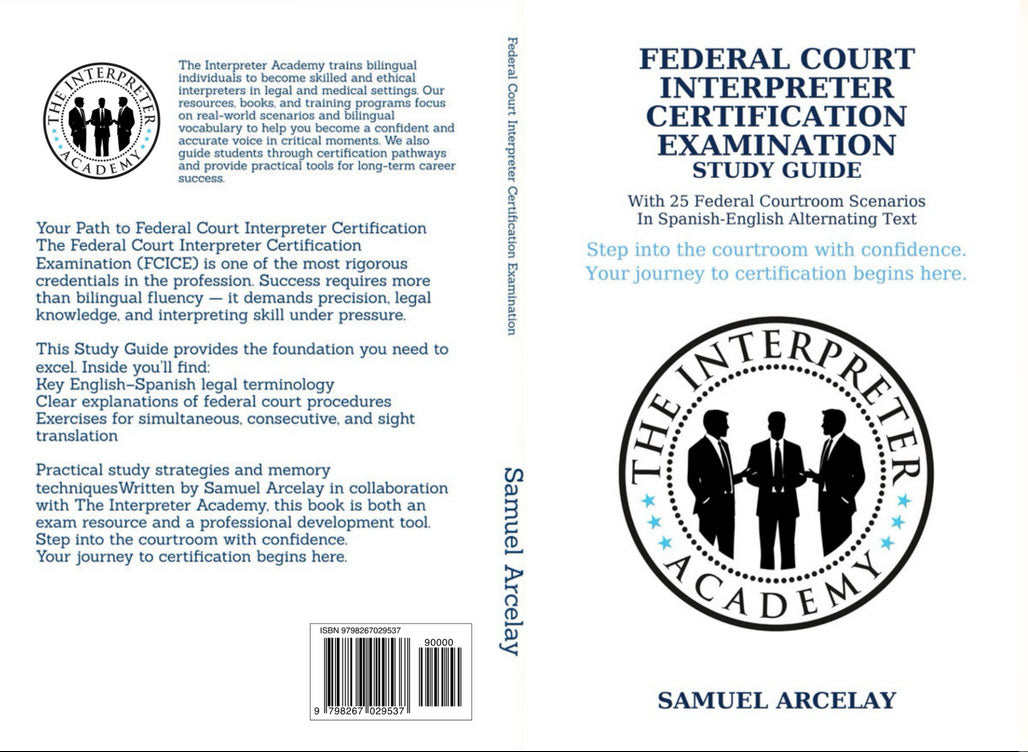
Federal Court Interpreter Certification Examination Study Guide

Federal Court Interpreter Certification Examination Study Guide

Federal Court Interpreter Certification

Examination Study Guide

With 25 Federal Courtroom Scenarios

In Spanish-English Alternating Text

By Samuel Arcelay / $19.99 / BUY ON AMAZON

FREE DELIVERY - FREE RETURNS

The Importance of Accurate Interpretation

As you begin your journey toward certification, it is important to understand what is at stake when interpretations are not accurate. In the courtroom, even a single word or phrase can change the outcome of a case. Certified interpreters are trusted to ensure that communication is precise, impartial, and faithful to the original meaning. The following examples illustrate how serious the consequences of inaccuracy can be:

Miranda Rights: If 'You have the right to remain silent' is interpreted as 'You must remain silent,' the defendant may believe they cannot speak at all. This error violates constitutional rights and may provide grounds for appeal.

Plea Agreements: If 'no contest' (nolo contendere) is interpreted as 'guilty,' the defendant could unknowingly waive rights, face harsher sentencing, or lose the ability to appeal.

Medical Testimony: If a witness says 'the patient lost consciousness' but it is rendered as 'the patient died,' the severity of the injury is drastically altered, which may influence the jury’s decision.

Financial Disputes: If 'loan' is interpreted as 'gift,' the court could wrongly believe that repayment was never expected, affecting the judgment on liability.

Criminal Charges: Confusing 'assault' with 'battery' could result in conviction for a more serious crime than intended by law.

Immigration Hearings: If 'asylum' is interpreted as 'residency,' a judge may deny protection to someone who faces real danger if deported.

Dates and Numbers: If 'fifteen' is interpreted as 'fifty,' the difference could lead to an unjust prison sentence length or an incorrect financial award.

These examples remind you why precision, training, and certification are essential. Every word matters in the courtroom, and accuracy is the foundation of justice.

These kinds of errors show why a certified court interpreter — who has proven mastery of legal terminology, procedures, and ethical standards — is essential for justice.

Federal Certification means you can get on a plane and travel all over the USA and your certification is valid.

State Certification Legal or Medical means you are certified on a state level.

The people that hire interpreters are usually lawyers, judges Courts, doctor’s corporation’s school’s social workers etc. They are at a professional college academic level. They are handling cases where people’s lives are at stake and property and freedom. This also includes lawsuits, deportations, family separation and judgments on medical situations that can represent large amounts of money or lengthy prison sentences.

It is not enough to be bi-lingual. Interpreting has rules and requires skill and adherence to ethical guidelines.

10.1 Why Terminology Matters (page?)

Terminology is the skeleton of legal discourse. Without the correct terms, your interpretation collapses. Errors in legal terminology are not cosmetic—they alter meaning, influence perception, and can lead to mistrials or appeals. Examiners in the FCICE are trained to listen for precise renderings of legal collocations. You must develop an ear and a tongue for these phrases until they roll out automatically.

‘Motion to suppress’ ≠ ‘moción para suprimir’ in every context; it requires contextual adjustment.

‘Beyond a reasonable doubt’ must be delivered in its accepted equivalent, not a literal variation.

‘Custodial interrogation’ has a fixed legal meaning; paraphrases dilute its weight.

As a professional Interpreter you will encounter:

ü  Graphic testimony:

ü  Aggressive crossexamination:

ü  Rapid judicial instructions:

ü  Sidebar/bench conferences:

That is why certification exists. It is proof that the interpreter has proven he or she can process the information in his or her chosen field and that he or she can be taken seriously by a judge, a lawyer, a doctor or a corporate executive.

2.8 Ethical Dilemma Scenarios (Added) (page?)

Consider the following situations and reflect on how you would respond:

ü  A defendant whispers a confession to you in Spanish during a break. What do you do?

ü  An attorney asks you to ‘tone down’ a witness’s angry outburst. Do you comply?

ü  You are asked to interpret slang you are unfamiliar with. How do you handle it without guessing?

The purpose and role of the legal interpreter go beyond bilingual ability. You are the safeguard of justice. You are the voice of those who cannot speak English, and the ears of those who cannot understand Spanish. Your neutrality ensures fairness. Your accuracy ensures justice. This is why the profession is demanding, and why it is deeply honorable.

Consider these real scenarios:

ü  A defendant in a narcotics case mishears a critical word. Without proper interpretation, they may think they are agreeing to years of prison when in fact they are not.

ü  A witness in a human trafficking case struggles to explain what happened. Your faithful interpretation ensures that their testimony is heard with clarity.

ü  A victim in an immigration fraud case weeps as they speak. Your role is to transmit their words accurately without being swayed by their emotion.

Chapter 16: Emotional Regulation in HighStress Settings (page?)

Interpreting in federal court places you in the middle of intense human drama. You will interpret testimonies of victims, confessions of defendants, arguments between attorneys, and rulings from judges. Stress is inevitable—but it can be managed.

2.2 Ethical Obligations (page?)

Accuracy and neutrality are the foundations of your role. No matter what is said, no matter how offensive or emotional, your duty is to interpret it faithfully. This includes profanity, slurs, and statements that may personally offend you. To edit or omit is to distort justice.

2.3 Professional Standing (page?)

Certified federal interpreters are respected members of the legal community. You will often work in cases involving sensitive or classified material. Judges, attorneys, and prosecutors will depend on you for accuracy. Your certification proves that you can operate at this level of trust and competence.

Think of the courtroom as a stage. Each participant—judge, attorney, witness—plays a role. The interpreter’s role is unique: you are both present and invisible. The focus must never be on you, yet nothing can proceed without you. This balance of importance and invisibility defines your professional standing.

Chapter 3: Federal Court Interpreter Certification Exam Overview (page?)

The Federal Court Interpreter Certification Examination (FCICE) exists to protect due process. Its purpose is to ensure that defendants, witnesses, and victims who do not speak English can fully participate in federal proceedings. This chapter explains what the exam measures, how it is structured, and how to approach its logistics with clarity and confidence.

Case Example:

During a trial, a defendant insulted the judge in Spanish using vulgar language. The interpreter, uncomfortable with repeating it, softened the insult. The court record no longer reflected the defendant’s true words. The judge reacted differently than he would have had he heard the real insult. This error highlighted why neutrality and accuracy are non-negotiable.

9.5 Numbers and Dates (page?)

Mistranslating a date or a dollar amount can alter the course of a trial.

These are just some of the reasons why certification is required on a professional level. Being bilingual is only part of the job. A professional interpreter must demonstrate skill and abide by ethical standards. He is she is part of a team of college graduates. Judges Lawyers District attorneys, corporate executives, doctors and mental health professionals, and forensic experts.

This is not going to happen overnight or in 30 or 90 days. Just as judge’s lawyers and doctors invest decades into their education, the certified interpreter, be it Federal or State, must put in their time in training.

Therefor take this book seriously and give yourself a good 6 months to a year to condition your reactions and skills to become automatic.

Once you have your certification identification and badge, and the privilege of working anywhere in the USA, you will feel proud of what you have earned.

 A Word Before You Begin

"The Longest Journey Begins with a Single Step"

“ Becoming a federally certified interpreter is one of the most demanding, yet rewarding professional journeys you can undertake. This book is not designed to be crammed or read like a novel. Each chapter is meant to be absorbed, practiced, and integrated into your daily routine. Patience is essential. Mastery comes from gradual assimilation, not rushing.

This role is unique and serious. You will stand beside lawyers, prosecutors, and judges. You will give voice to defendants in cases ranging from traffic violations to murder. You will witness trauma, injustice, and triumph, yet remain objective and neutral. If you choose this path, embrace it fully. You are about to train both your mind and your memory to serve justice with precision and integrity.”

Courtroom interpreting is not a skill to be taken lightly. It is a profession that demands not only linguistic precision but also mental fortitude and ethical clarity. From the very first moment you step into a federal courtroom, you will be challenged in ways that test your preparation, resilience, and ability to remain composed under pressure.

This opening section is not meant to intimidate you—it is meant to prepare you. By reading and internalizing what follows, you will set the foundation for success in one of the most demanding examinations and professions in the legal system.

Interpreting offensive or vulgar language without altering a word.

Rendering testimony that is emotional, chaotic, or disorganized.

Maintaining accuracy in long, complex sentences filled with legal terminology.

Delivering simultaneous interpretation at the speed of a judge’s instructions.

Remaining composed when proceedings take unexpected turns.

Adapting to accents, regionalisms, and rapid changes in speech patterns.

Switching modes instantly when asked to sight-translate a document, then return to consecutive.

Managing fatigue during lengthy proceedings where every second requires full concentration.

The Honor of the Role

While the demands are heavy, the honor of serving as a certified federal interpreter is profound. You are entrusted with a role that protects constitutional rights and ensures that justice is not limited by language. Every word you interpret may influence a verdict, a sentence, or the perception of credibility.

Your accuracy shapes the record of history in each case. The interpreter’s voice becomes the bridge through which justice speaks. To wear this responsibility is to carry a duty of the highest order.

Are You Ready?

Before committing yourself to this path, reflect deeply. Certification is not granted easily—it is the result of months and even years of disciplined preparation. The exam is designed to filter only those who can remain faithful to the record, calm under stress, and precise under pressure.

View full details