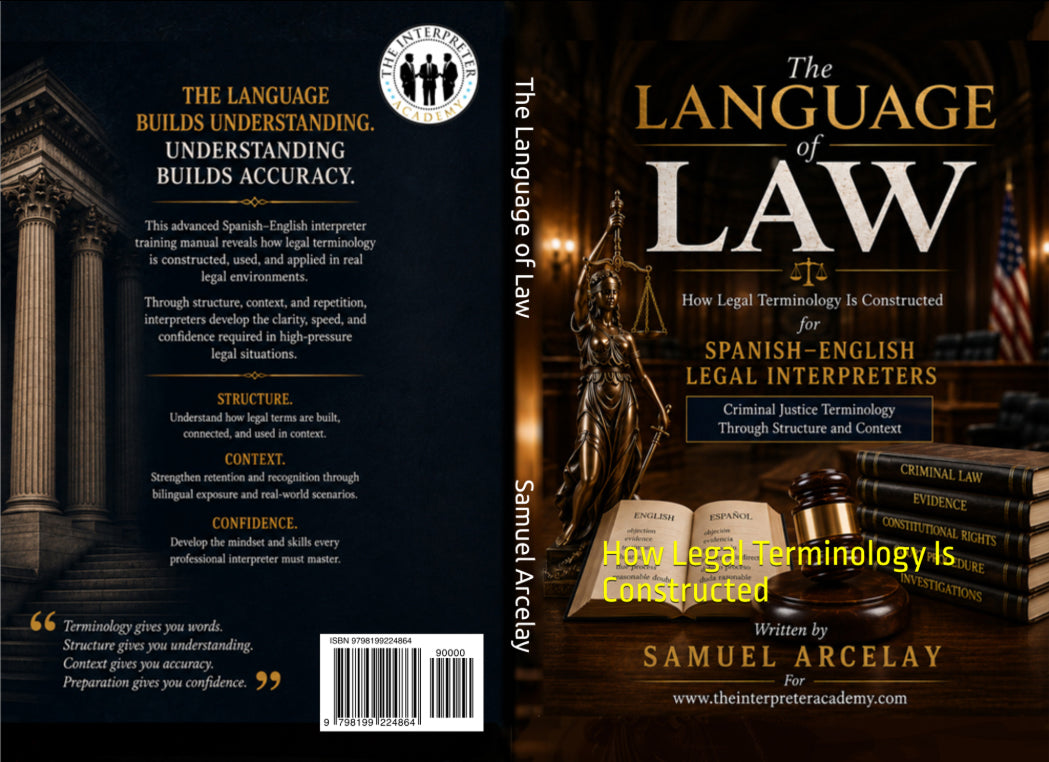
The Language of Law: How Legal Terminology Is Constructed
The Language of Law: How Legal Terminology Is Constructed
THE LANGUAGE OF LAW
How Legal Terminology Is Constructed for Spanish-English Legal Interpreters
Criminal Justice Terminology Through Structure and Context
By Samuel Arcelay | The Interpreter Academy
BUY NOW ON AMAZONFREE DELIVERY • FREE RETURNS
Stop Memorizing Legal Vocabulary
Start understanding how legal language actually works.
Most legal interpreter resources focus on endless lists of isolated words. The Language of Law takes a completely different approach.
This book teaches Spanish-English legal interpreters how legal terminology is constructed, organized, and connected through procedural systems, courtroom functions, legal concepts, institutional language patterns, and real-world communication.
Rather than relying on rote memorization, interpreters learn to recognize legal terminology as a structured language system.
Inside This Book You Will Learn
- Criminal Law Terminology & Criminal Procedure
- Police Investigations, Arrest Procedures & Miranda Terminology
- Courtroom Structure, Trial Participants & Judicial Procedure
- Immigration Court & Removal Proceedings
- Family Court, Custody Proceedings & Domestic Relations
- Civil Litigation & Lawsuit Procedures
- Depositions, Sworn Testimony & Attorney-Client Communication
- Evidence, Exhibits & Forensic Terminology
- Juvenile Court Terminology
- Cybercrime & Digital Evidence Terminology
- Sentencing, Corrections & Incarceration Terminology
- Appellate Law & Appeal Procedures
- Administrative Hearings & Government Agency Communication
- Medical & Psychological Terminology Frequently Encountered in Legal Proceedings
- Real-Time Sight Translation & Document Interpretation
- Courtroom Objections, Judicial Control Language & Trial Dynamics
- High-Pressure Trial Simulations
- Rapid Review Glossary & Professional Development Guidance
What Makes This Book Different?
The Interpreter Academy's teaching philosophy goes beyond vocabulary acquisition.
This book teaches interpreters how to think structurally about legal language systems.
Legal terminology becomes easier to understand when interpreters recognize procedural structure, courtroom function, terminology families, legal concept categories, institutional language, Latin legal terminology, and realistic bilingual scenarios.
- Procedural Structure
- Terminology Families
- Legal Concept Categories
- Courtroom Dynamics
- Institutional Language Patterns
- Latin Legal Terminology
- Context-Based Learning
- Realistic Bilingual Scenarios
By understanding how legal terminology functions within the justice system, interpreters develop stronger retention, faster recognition, improved confidence, and greater professional fluency under pressure.
Build Legal Confidence
Understand legal terminology through procedural structure instead of memorizing disconnected vocabulary.
Improve Courtroom Accuracy
Learn how legal categories, courtroom roles, procedures, documents, and trial dynamics work together.
Recognize Legal Systems
Develop faster recognition of legal language patterns used in criminal court, immigration, family court, civil litigation, and more.
Learn the Structure. Understand the System. Interpret with Confidence.
A practical legal terminology training system for Spanish-English legal interpreters, court interpreters, interpreter trainees, and bilingual legal professionals.
BUY NOW ON AMAZONThe Interpreter Academy develops practical educational systems for interpreters.
```