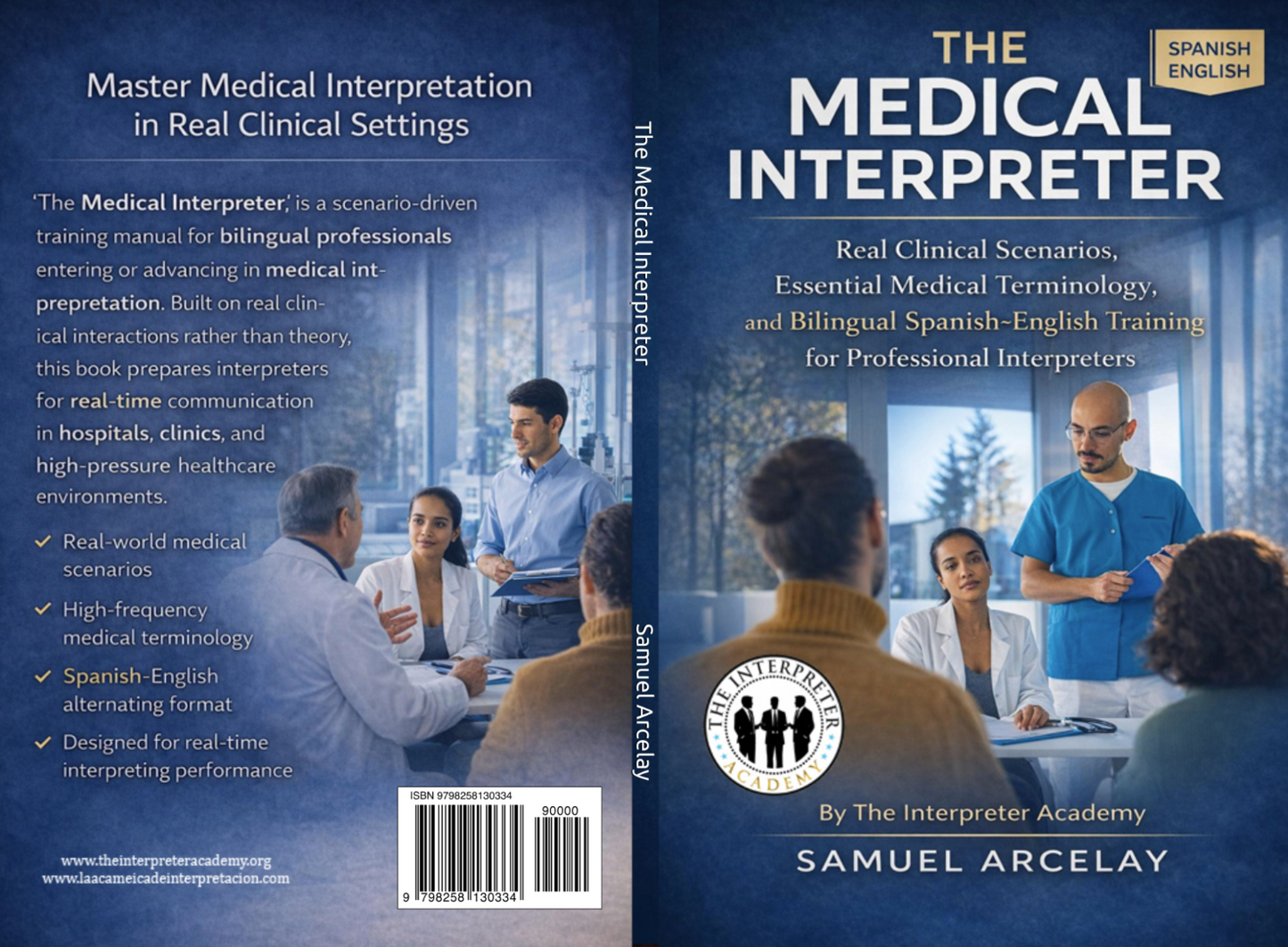
The Medical Interpreter: Real Clinical Scenarios, Essential Medical Terminology, and Bilingual Spanish–English Training for Professional Interpreters by Samuel Arcelay
The Medical Interpreter: Real Clinical Scenarios, Essential Medical Terminology, and Bilingual Spanish–English Training for Professional Interpreters by Samuel Arcelay
Summary
"The Medical Interpreter" is a scenario-driven training manual designed for bilingual professionals entering or advancing in medical interpretation. Built on real clinical interactions rather than theory, this book removes unnecessary filler and delivers exactly what the interpreter needs: vocabulary in context, repetition through application, and exposure to real-world medical communication. Written in alternating Spanish and English, it creates a direct cognitive bridge between both languages, allowing the reader to internalize terminology efficiently. This book assumes a foundational level of bilingual ability and immerses the reader into hospitals, clinics, and patient care environments—where accuracy, speed, and composure are essential.
The Medical Interpreter
Patient Intake & Clinical Dialogues
Professional Spanish–English Medical Interpreter Training System
FREE SHIPPING • FREE RETURNS
The Medical Interpreter is a scenario-driven professional training system created for Spanish-English medical interpreters, bilingual healthcare professionals, interpreting students, and language specialists seeking real-world medical fluency inside clinical environments.
Unlike traditional interpreter textbooks overloaded with theory and unnecessary filler, this book focuses on what actually develops interpreter skill:
- Vocabulary in context
- Realistic clinical dialogue
- Repetition through exposure
- Rapid terminology recall
- Pressure-based language processing
- Authentic medical communication
Written in a strict alternating Spanish-English format, this system creates a direct cognitive bridge between both languages, helping interpreters strengthen:
- Accuracy
- Fluency
- Speed
- Retention
- Professional confidence
Built for Real Medical Environments
This is not passive reading.
This is active interpreter training.
Every scenario mirrors the environments interpreters actually face inside:
- Hospitals
- Emergency rooms
- Medical clinics
- Patient intake departments
- Diagnostic consultations
- Treatment discussions
- Administrative encounters
- Sensitive medical conversations
Readers are trained to process, retain, and reproduce language under realistic clinical pressure.
Inside This Volume
- Authentic Clinical Scenarios covering real patient-provider communication
- Medical Terminology in Context instead of isolated memorization
- Patient Intake & Evaluation Dialogue
- Emergency Care Communication
- Administrative & Insurance Conversations
- Emotionally Complex Medical Encounters
- High-Frequency Medical Vocabulary Exposure
- Alternating Spanish-English Training Format
Why This Training System Works
Medical interpreters do not develop fluency through memorization alone.
They develop fluency through:
- Exposure
- Repetition
- Contextual learning
- Realistic dialogue processing
- Consistent scenario review
This training system helps interpreters strengthen:
- Consecutive interpreting skills
- Simultaneous interpreting development
- Listening precision
- Medical terminology retention
- Confidence inside high-pressure environments
- Professional first-person interpreting discipline
Developed for Serious Interpreters
Samuel Arcelay developed The Medical Interpreter from direct experience with the pressures, uncertainty, and rapid language demands encountered inside real interpreting environments.
Influenced by behavioral science and contextual learning principles, this book was intentionally structured to help interpreters mentally possess the language before entering professional medical settings.
The result is a practical working tool designed for:
- Career advancement
- Professional confidence
- Medical terminology mastery
- Real-world interpreter preparation
From The Interpreter Academy
The Interpreter Academy develops immersive professional training systems for interpreters working in legal, medical, and institutional environments.
The training philosophy emphasizes:
- Contextual learning
- Realistic dialogue exposure
- Behavioral retention principles
- Professional performance development
- Practical bilingual fluency
Professional Medical Interpreter Training
Synopsis
Samuel Arcelay developed "The Medical Interpreter" from real experience in the field—moments of pressure, uncertainty, and the constant demand for precision. Rather than relying on traditional teaching methods, this book reflects how interpreters actually learn: through exposure, repetition, and context. Every scenario mirrors authentic medical encounters, forcing the reader to think, process, and respond as an interpreter would in real time. Arcelay’s background in behavioral science is evident throughout, emphasizing that interpreters must first possess the words mentally before they can deliver them effectively. This is not a passive reading experience—it is active training.
Assumptions and Focus
"The Medical Interpreter" assumes the reader already speaks English and Spanish and understands the basic concept of interpreting. It avoids introductory material such as certification processes or ethics, and instead focuses on what truly develops skill: exposure to medical terminology within real scenarios. From routine check-ups to emergency situations, the reader is trained to recognize, retain, and reproduce language under pressure. The goal is direct—build immediate recall and confident delivery in real medical environments.
Bilingual Format
The book is written in a strict alternating Spanish-English format, reinforcing comprehension without breaking focus. This structure minimizes reliance on dictionaries and mirrors the mental switching required during live interpretation. By repeatedly processing both languages side by side, the reader strengthens fluency, accuracy, and speed.
Content and Benefits
This book provides a wide range of medical scenarios across multiple areas of healthcare, including patient intake, diagnosis, treatment planning, administrative communication, emergency care, and sensitive medical conversations. Each scenario simulates real interpreting conditions, requiring attention, memory, and precision.
Key benefits include:
-
Rapid acquisition of high-frequency medical terminology
-
Context-based learning that improves retention
-
Development of simultaneous and consecutive interpreting skills
-
Increased confidence in high-pressure environments
-
Exposure to emotionally and culturally complex interactions
-
Reinforcement of first-person interpreting discipline
The structure allows interpreters to train actively during downtime—reviewing scenarios, reinforcing vocabulary, and sharpening skills. Mastery comes from consistent exposure and daily practice.
Conclusion
"The Medical Interpreter" is not a traditional textbook—it is a working tool. It is designed for interpreters who understand that this profession demands preparation, discipline, and constant improvement. Whether pursuing certification or already working in the field, this book equips you with the language, structure, and confidence to perform effectively in real medical settings.