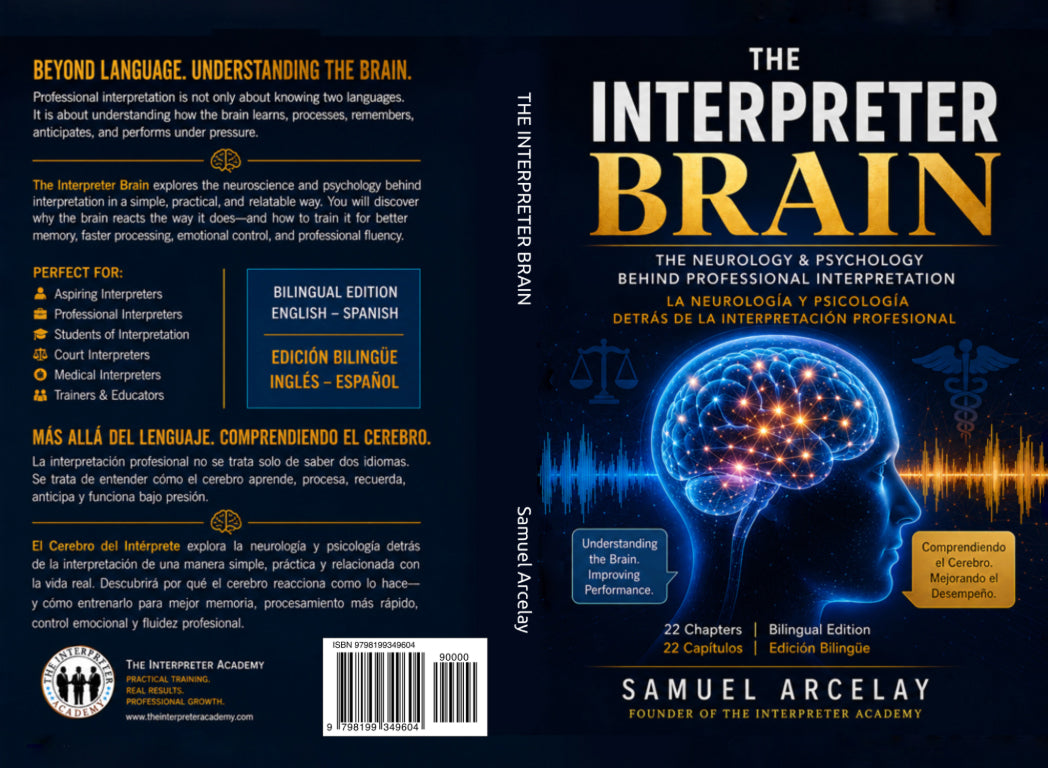
The Interpreter Brain | The Psychology & Neuroscience
The Interpreter Brain | The Psychology & Neuroscience
THE INTERPRETER BRAIN
How the Brain, Mind & Subconscious Mind Process Language Under Pressure
By Samuel Arcelay | The Interpreter Academy
BUY NOW ON AMAZONFREE DELIVERY • FREE RETURNS
Understanding the Interpreter Brain
Most interpreter books teach vocabulary.
Few explain what is happening inside the interpreter's brain.
Why do experienced interpreters remain calm under pressure? Why do certain words suddenly disappear during stressful assignments? Why does repetition improve fluency? Why do realistic scenarios create stronger learning than memorized vocabulary lists?
The Interpreter Brain explores psychology, neuroscience, memory systems, subconscious conditioning, emotional regulation, visualization, pattern recognition, contextual learning, and professional performance.
Inside This Book
- How the brain learns through repetition
- Why realistic scenarios improve retention
- How the subconscious mind recognizes patterns
- Why fear interferes with memory retrieval
- How visualization improves performance
- Why context accelerates learning
- How interpreters develop confidence
- How exposure reduces anxiety
- The psychology behind legal and medical interpretation
- How interpreters develop long-term professional fluency
What Makes This Book Different?
The Interpreter Academy does not simply teach vocabulary.
We teach interpreters how to think structurally about language systems.
By understanding how the brain, mind, and subconscious mind work together, interpreters can improve memory, strengthen confidence, reduce anxiety, and accelerate professional development.
More Books by Samuel Arcelay
Explore interpreter training, legal terminology, medical terminology, psychology, and professional development resources.
VIEW AUTHOR PAGE ON AMAZON